Digital Marketing in Marrakech for Riads, Hotels & Restaurants
September 18, 2026
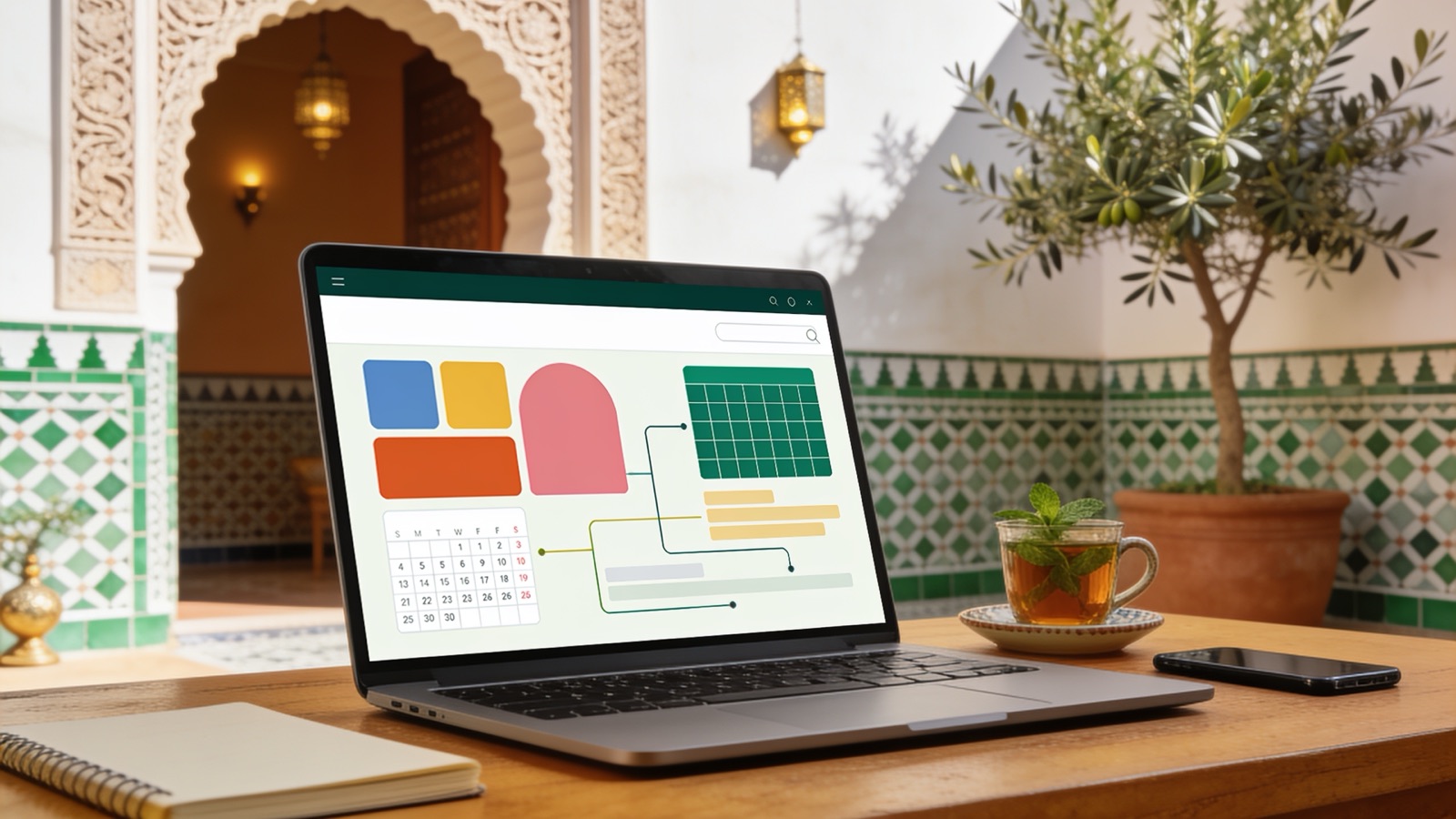
AI content automation for businesses in Morocco and MENA: an 8-step method, tools, limits and why human editing keeps quality, accuracy and trust high.
Automating content creation with AI in Morocco means letting tools such as ChatGPT, Claude or Gemini handle repetitive tasks (first drafts, variations, summaries) while humans stay in charge of the brief, fact-checking, localisation and final approval. AI speeds up production; people keep it accurate and on-brand.
Whether you run an SME, a startup or an established brand in Casablanca, Rabat or Marrakech, the pressure is the same: publish consistently on your website, social media and email, in French, often in Arabic or darija, and sometimes in English for international and MENA audiences. Generative AI can keep up with that pace, as long as a clear method frames it. Here is an eight-step workflow.
AI-assisted writing is a content production method in which a generative AI tool helps a human writer research, structure, draft or rephrase a text, while the human sets the intent, checks the facts, adapts the tone and approves the published version. The AI acts as an assistant, never as the final accountable author.
Fully AI-generated content is published as it comes out of the tool. It is fast, but it risks generic phrasing, an off-brand tone and hallucinations: invented figures, non-existent sources, misquoted regulations. AI-assisted content combines machine speed with human judgement: every piece is reviewed, verified, enriched with real examples and tailored to its audience.
Not as such. Google has said publicly that it rewards helpful, reliable, people-first content regardless of how it is produced. However, using automation to mass-publish low-value pages primarily to manipulate rankings violates its spam policies. The deciding factor is not the tool but the real usefulness of the content to the reader.
The E-E-A-T criteria (experience, expertise, authoritativeness, trustworthiness) described in Google's quality rater guidelines explain what makes content credible. An AI has no lived experience of your market: it has not met your customers or tested your products. That is exactly what humans must add: field examples, expert insight, genuine customer feedback, a named author and verifiable information.
Step 1 – The brief: define the goal of the piece, the target audience, the search query, the key message, the language and the call to action. A precise brief is the best defence against generic text. It also becomes the base instruction for the AI tool and the review checklist for the human editor.
Step 2 – Research: study your customers' real questions, current search results, Search Console data and feedback from your sales team. AI can help cluster ideas or suggest an outline, but facts, figures and references must come from sources you can cite and verify yourself.
Step 3 – The AI draft: give the tool your brief, outline, editorial guidelines and samples of your brand's writing. Ask for a draft, not a finished piece. The richer the context, the lighter the rewrite. Keep a library of tested prompts for each content type so quality stays consistent across the team.
Step 4 – Human fact-checking and localisation: an editor checks every claim, removes anything unverifiable, adds examples specific to the Moroccan market and adapts cultural references. This is also where the brand voice comes back in: vocabulary, register, formality and phrases to avoid.
Step 5 – SEO optimisation: refine the title, meta description, heading structure, internal links and direct answers to common questions. To be picked up by answer engines and AI assistants, open each section with a short, clear answer, then expand with concrete detail.
Step 6 – Multi-format repurposing: one in-depth article can become several LinkedIn posts, an Instagram carousel built in Canva, a reel or short-video script, a newsletter section and a set of FAQs. AI is very effective at this repurposing work, provided every version is reviewed before it goes out.
Step 7 – The publishing calendar: plan posts by channel, language and theme, taking Moroccan key moments into account, such as Ramadan, national holidays and the back-to-school period. A shared calendar prevents gaps and duplicates, and protects time for review.
Step 8 – Measurement: track impressions and positions in Search Console, traffic and conversions in your analytics tool, engagement on social media, and open and click rates for your newsletter. This data feeds the next brief and improves the workflow with every cycle.
Morocco's linguistic landscape calls for clear choices. French remains widely used in B2B, on websites and in professional exchanges. Modern Standard Arabic is expected in many institutional communications, while darija often dominates social media and video formats. English is increasingly useful for reaching international clients, investors and the wider MENA region.
Translating AI output word for word rarely works. Each language deserves real adaptation: examples, humour, references and even arguments change with the audience. Darija in particular is an oral, varied register that AI tools handle unevenly, so review by a native speaker is essential before anything is published.
Automate or assist: article outlines, first drafts, headline variations, summaries, social media adaptations, video transcription, meta descriptions and topic ideas. These are repetitive, time-consuming tasks where AI saves valuable hours for your team without making strategic or editorial decisions on your behalf.
Keep human: editorial strategy, positioning, fact-checking, sensitive or regulated topics, testimonials and case studies, customer replies, final approval and anything published in the name of leadership. Whatever affects the company's reputation, credibility or legal liability should always go through an identified, accountable person.
Never paste customers' personal data, prospect lists or confidential information into a public AI tool. In Morocco, Law 09-08 governs the processing of personal data, under the oversight of the CNDP, the national data protection authority. Anonymise examples, prefer business plans with clear terms, and write an internal AI policy: approved tools, prohibited data, mandatory human review.
An in-house team knows the business and reacts quickly, but takes time to hire, train and manage. A freelancer offers flexibility and focused expertise for one-off needs. A content creation agency brings a method, combined skills in writing, SEO, design and video, and continuity of production. Many businesses combine approaches: strategy and approval in-house, production outsourced.
Tie each piece to one goal: visibility, leads, sales or retention. Then track organic positions and clicks, qualified traffic, quote requests, newsletter sign-ups and attributed conversions, and compare them with the time and budget invested, including review time. For organic search, assess results over several months rather than week by week.
No. AI speeds up drafts and variations, but it does not know your market, your customers or your business goals. It can get facts wrong and default to a generic tone. A writer or agency brings the strategy, verification, localisation and editorial accountability that make content credible and effective.
Conversational assistants such as ChatGPT, Claude or Gemini help with ideation, outlines and first drafts. Canva makes it easier to produce visuals and carousels. Add a social scheduling tool, Google Search Console and an analytics platform. The choice of tool matters less than the method and the quality of the instructions you provide.
Current tools produce Modern Standard Arabic of variable quality and darija that is still uneven, sometimes with awkward phrasing or expressions borrowed from other dialects. They can be a starting point, but every text should be reviewed and adapted by a native speaker who knows the audience, especially on social media, where authenticity matters.
AI is a powerful accelerator for content production, but it does not replace strategy, verification or knowledge of the Moroccan market. The winning approach combines a precise brief, an AI-assisted draft, rigorous human editing, SEO optimisation and ongoing measurement. ARTCOM DIGITAL, an agency based in Marrakech, creates content in French and English, and in Arabic with partners. Get in touch for a free quote.
September 18, 2026
September 18, 2026
Whether you're launching a new project, refreshing your brand, or want to grow your online presence, we're here to bring your ideas to life. Let's collaborate to create something meaningful, tailored to your goals and ready to make a difference.
Get a quoteGet a quote