AI Content Creation in Morocco: Method, Tools and Limits
September 18, 2026
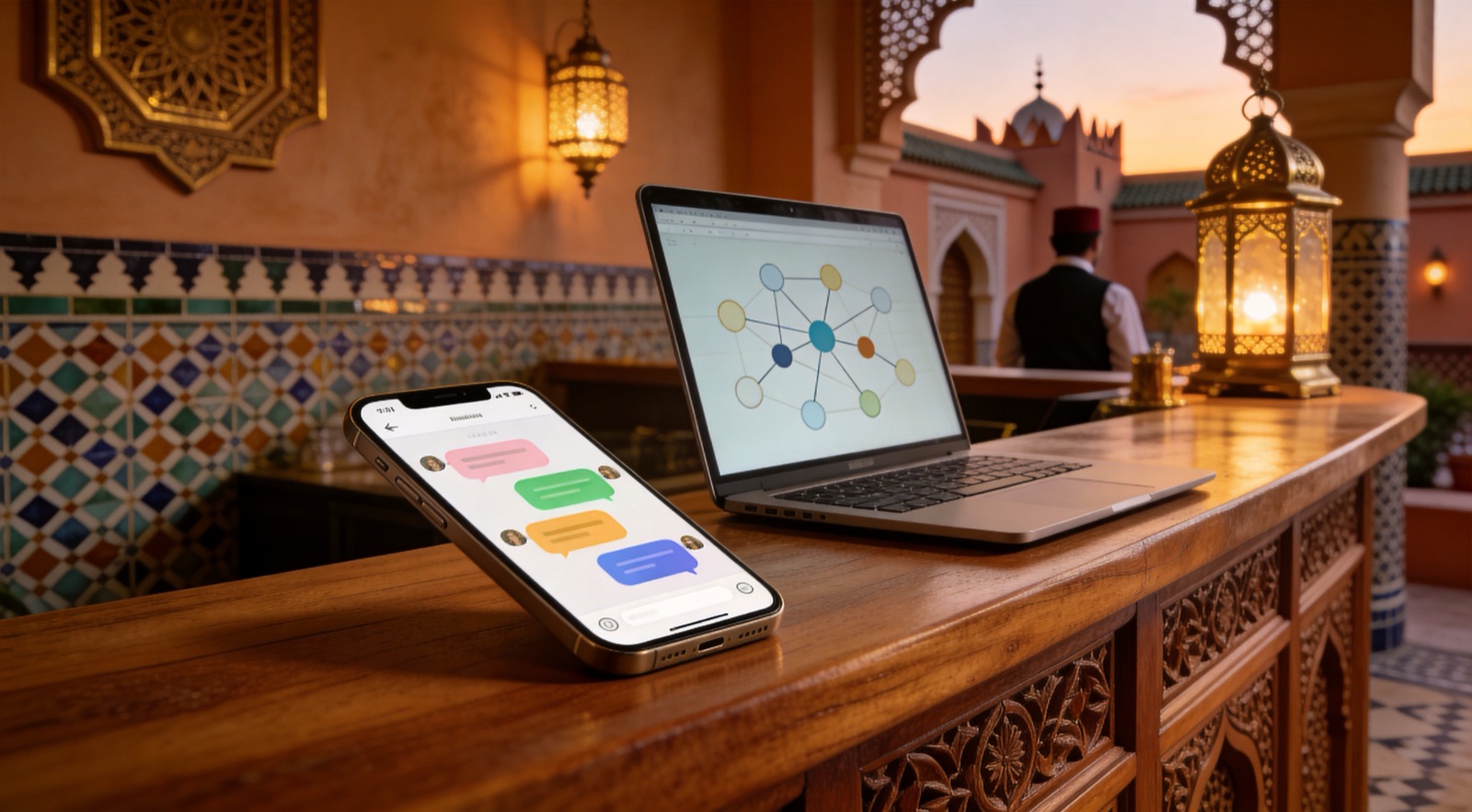
Conversational AI in Morocco: WhatsApp chatbots, AI helpdesks and AI agents. Use cases, project steps, Law 09-08 compliance and how to measure ROI.
Conversational AI covers chatbots and AI agents that understand a written or spoken message and reply naturally, around the clock. In Morocco, it is mostly used to automate WhatsApp, customer service and order handling, as long as it is grounded in your real data, compliant with Law 09-08, and backed by a clear human handoff.
Riads get booking requests at 2 a.m., online stores have to confirm every cash-on-delivery order, and clinic front desks are constantly overloaded. Across Morocco, teams spend a large part of their day answering the same questions on WhatsApp. AI-powered CX solutions promise relief, but the market is noisy and many offers are vague about what they actually deliver.
This guide is written for decision-makers. It explains what these tools really do, where they work best by sector in Morocco, how a project runs, what to ask a conversational AI consultancy before hiring one, which risks to manage, and how to tell whether the investment is paying off.
A traditional chatbot follows a decision tree: users tap buttons and get pre-written answers. A chatbot built on a large language model (LLM) understands free-form sentences instead. It handles typos, rephrases, and can reply in French, Arabic, English, or Darija written in Latin script.
An AI helpdesk goes a step further. It draws on your knowledge base, such as FAQs, terms of sale, product sheets and internal procedures, to answer support requests, sort tickets by urgency and draft replies for your agents. The goal is not to replace the support team but to take repetitive questions off its plate so people can focus on cases that need judgment.
An AI agent does more than answer: it takes action. Connected to your tools through APIs, it can check availability in a booking system, create an order, look up a delivery status, update a CRM record or schedule an appointment. When the AI chains several of these steps to reach a goal, we call it an agentic workflow, with explicit rules about what it may do alone and what requires human approval.
In Morocco, WhatsApp is the default way most customers reach a business, well ahead of email or website forms. Automating it properly means using the WhatsApp Business Platform, Meta's official API, through an approved provider, rather than unofficial tools that put your number at risk of being banned. The API has rules: customer opt-in, a 24-hour customer service window for free-form replies, and approved message templates outside that window.
Riads, hotels and travel agencies: instant answers about availability, indicative rates, airport transfers and excursions in the traveler's language, with booking requests passed to the front desk for confirmation.
E-commerce with cash on delivery: automatic WhatsApp order confirmation before shipping, parcel tracking, answers about sizes and delivery times, and abandoned-cart follow-ups. Confirming orders upfront helps cut the refused parcels and returns that come from unconfirmed orders.
Clinics, medical practices and beauty centers: booking and reminders, practical information such as hours, location and documents to bring, under one strict rule: the AI never gives medical advice and hands any clinical question to staff immediately.
Real estate: lead qualification by budget, neighborhood, property type and buy-or-rent intent, sending matching listings and booking viewings, so advisors only call back serious prospects.
Step 1, scoping: identify the most frequent and most time-consuming conversations, set a narrow scope and measurable goals. Two or three well-defined use cases beat an assistant that is supposed to do everything on day one.
Step 2, knowledge base and integrations: gather and clean trusted content such as prices, return policies and procedures, then connect the tools the assistant needs, for example your CRM, booking software, online store or a shared spreadsheet. Answer quality depends directly on the quality of these sources.
Step 3, design and testing: define tone, languages, limits and human handoff rules, then test on real anonymized conversations, including Darija messages, ambiguous requests and deliberate attempts to push the assistant off track.
Step 4, gradual rollout and continuous improvement: open the assistant to part of the traffic first, review conversations weekly, fix the knowledge base and tune the rules. An AI assistant is never finished; it improves with use.
What sources will the assistant answer from? A serious agency explains how it restricts the AI to your approved content (an approach known as RAG) and what happens when the answer is not there: the assistant should say so and offer a human, not make something up.
Where is the data hosted, and who can access it? Ask which vendors and models are used, which countries conversations pass through, how long they are stored, and how compliance with Morocco's Law 09-08 is handled.
How does the human handoff work? Ask for a live demo: what triggers a handoff, how the team is notified, and whether the agent sees the full conversation history so the customer does not have to repeat themselves.
Who owns what, and what are the running costs? Clarify ownership of the WhatsApp number, the content and the data, plus recurring costs: platform subscription, Meta's per-conversation WhatsApp pricing and AI model usage.
Hallucinations: a language model can confidently state something false, such as a price or a cancellation policy that does not exist. You reduce this risk by grounding answers in a controlled knowledge base, forbidding the AI from committing on certain topics (discounts, refunds, medical or legal advice) and reviewing conversations regularly.
Data protection: in Morocco, any processing of personal data falls under Law 09-08, supervised by the CNDP (the national commission for the protection of personal data). In practice this means informing customers, collecting only what you need, securing access, completing the required CNDP formalities and properly framing data transfers abroad, which are common with cloud services.
Human handoff: some customers simply want a person, and some situations demand one, such as complaints, upset customers or sensitive requests. The assistant must recognize these cases, be upfront that it is an AI and hand over quickly. A bot stuck in a loop destroys more trust than it builds.
Measure before and after launch over comparable periods, and review unanswered questions and handoff reasons monthly to improve the knowledge base. Useful metrics include the share of conversations resolved without human help, first response time, volume handled outside business hours, handoff rate, post-chat customer satisfaction and, on the business side, appointments booked, orders confirmed or reservations generated through the channel.
Yes. Recent language models understand written Darija reasonably well, both in Arabic script and in Latin script with numbers such as 3, 7 and 9, but quality is still below French or Modern Standard Arabic. Test the assistant on real messages from your customers and set up a human handoff whenever understanding is uncertain.
If your chatbot collects or processes personal data, such as a name, phone number or delivery address, that processing falls under Law 09-08 and requires the formalities set out with the CNDP, either a declaration or an authorization depending on the case. Have your specific situation checked by a lawyer or directly with the CNDP.
It mostly depends on scope and integrations. An assistant limited to FAQs and lead capture goes live much faster than an agent connected to booking software or a CRM. The real bottleneck is often preparing reliable content, followed by the testing phase on real conversations.
No, it takes load off the team. The AI agent absorbs repetitive questions and after-hours messages, while people keep complaints, negotiations and sensitive cases. Businesses that get this right redirect the time saved toward customer follow-up and sales instead of trying to remove human contact altogether.
Conversational AI pays off in Morocco when it solves a specific problem: too many WhatsApp messages, an overloaded support team, or leads lost after hours. Success depends less on the technology than on scoping, data quality, compliance with Law 09-08 and a well-designed human handoff. ARTCOM DIGITAL, based in Marrakech, works with businesses across Morocco and the MENA region to design and integrate WhatsApp chatbots, AI helpdesks and AI agents. Tell us about your project to get a free quote.
September 18, 2026

September 18, 2026
Whether you're launching a new project, refreshing your brand, or want to grow your online presence, we're here to bring your ideas to life. Let's collaborate to create something meaningful, tailored to your goals and ready to make a difference.
Get a quoteGet a quote